Dental implants
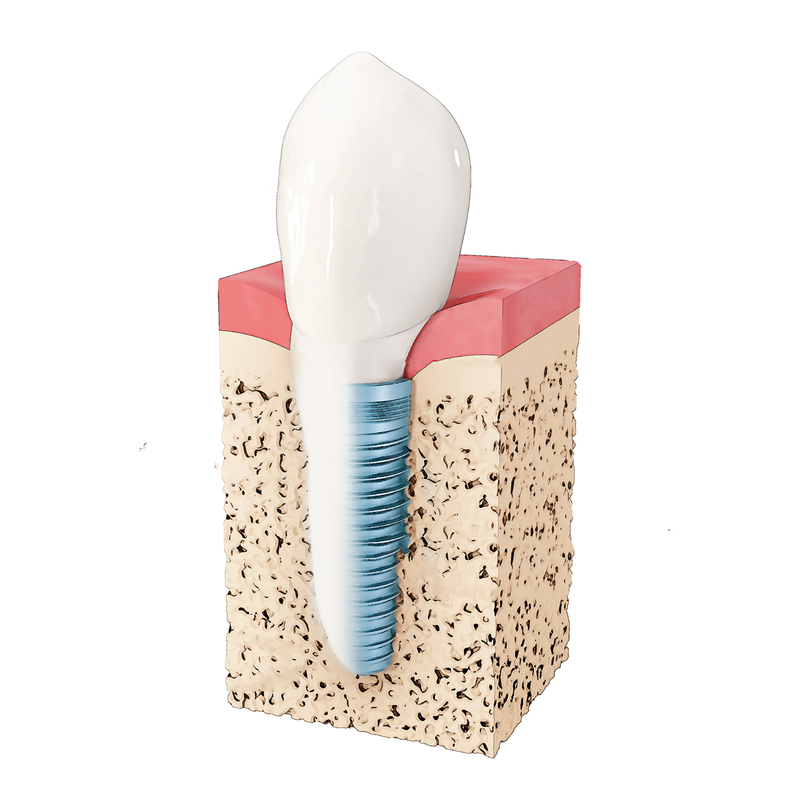
A dental implant is an artificial tooth root made of titanium which is used to replace a missing tooth. The dentist inserts the implant into the jaw bone, where the titanium fuses with the bone. As before, the tooth root, now the implant creates a stable base for the crown, which in turn will be a visible part of the new tooth.
Dental implants are very small, usually about 10 mm long and only 3-5 mm wide at the apex.
It is widely believed that dental implants are the most effective method of restoring missing teeth today because they offer many benefits to patients.

Natural smile
A dental implant looks like a real tooth. All tooth characteristics such as color, shape and contour can be adjusted. The result will be a natural smile that will restore self-confidence and improve the quality of life. With the new shiny teeth visible on the outside, well-being will also return.

Eating and talking the right way
Have you had to give up your favorite dishes since you lost your teeth? Do you feel uncomfortable talking to colleagues and friends because dentures or missing teeth prevent you from speaking clearly? Dental implants will restore all the functions of real teeth. Regardless of how hard, crunchy or sticky you like, thanks to dental implants they will return to your menu. Implants will restore clear speech at your next business presentation or during long conversations with friends.

The adjacent teeth remain intact
When performing other restorative methods, it is often necessary to grind the adjacent teeth to secure the restoration in the mouth. Dental implants do not adversely affect the adjacent teeth.
Stable and well-fitted
Due to the fact that dental implants are adapted to the jaw bone, they are usually much more comfortable and provide long-term stability compared to other methods of tooth reconstruction. Moreover, they are made of biocompatible materials, which means that they are not treated by the body as a "foreign body". Dental implants are therefore a solution that best imitates natural teeth.
A long-lasting and effective solution
When performing other restorative methods, it is often necessary to grind the adjacent teeth to secure the restoration in the mouth. Dental implants do not adversely affect the adjacent teeth.
Profitability
Implant treatment is believed to be a long-term investment in health and wellness - an investment in life. Compared to other methods of rebuilding, the costs may initially appear higher. However, higher maintenance costs, possible further loss of the jaw bone, and eventually the loss of more and more teeth can make other restorations more expensive in the long run.
Diagnostics and treatment planning
1
First, the dentist will carefully evaluate the condition of the teeth to see if there are any contraindications to treatment with dental implants. It is important that the gums and jawbone are not inflamed. If necessary, these types of diseases are treated before surgery. During diagnosis, the dentist also assesses the type of bone in the jaw and how much is left. Over the years of life with missing teeth, the jaw line can be significantly reduced. In this case, the dentist will discuss alternative treatments that will enable the implementation of dental implants. The dentist may decide to use devices and software that will create a 3D image of the oral cavity, which will allow you to plan the course of treatment. This will help the dental team during the procedure as they will be able to choose the best angle and depth for the implant.
Implant placement
2
Implantation is usually performed on an outpatient basis and thanks to local anesthesia the patient does not feel anything. Depending on the condition of the oral cavity, dental implants are implanted during one or more treatments.
Final restoration
3
After the procedure, the dentist places a temporary crown, bridge, or even a small plastic cap on the implant, which at this time is to connect to the jaw bone. The process of connecting the implant and bone is called osseointegration. Depending on individual predispositions, it may take from several weeks to several months. In the meantime, the dentist and the dental laboratory will design and perform the final restoration. The adjusted crown, bridge, or beam is then attached to the implant with a tiny wedge or cement.